A gas dryer is one of the most common places for a small leak to develop in a home – the connection point behind the machine sees constant vibration every time it runs, which can gradually loosen fittings over months or years. Catching a leak early matters, both for safety and for avoiding a much bigger repair down the road. This guide walks you through exactly how to check, safely, and what to do with what you find.
It’s worth understanding why this specific connection is more prone to leaks than, say, a gas line feeding a furnace or water heater. Dryers move – not much, but enough over years of use that the flexible line and its fittings take on repeated small stresses a stationary appliance never sees. Add in the fact that most homeowners rarely look behind a dryer once it’s installed, and it’s easy to see why this is one of the more common spots for a slow leak to go unnoticed for a while.
Before we start: if you already smell a strong, persistent gas odor – often described as rotten eggs or sulfur – skip the troubleshooting steps below. Leave the house, don’t flip any switches on your way out, and call for emergency gas leak repair from outside. The steps in this guide are for confirming a suspected leak, not for situations where the smell is already obvious. For a full breakdown of what to do in that scenario, see our guide on what to do when you smell gas.
Step 1: Know What You’re Looking For
Gas leaks around a dryer typically show up in one of three ways: a faint sulfur-like odor near the machine (not necessarily filling the room), a hissing sound coming from behind the unit, or higher-than-usual gas bills with no obvious explanation. If you’re not sure whether your dryer even runs on gas, our guide on how gas dryers work and how to tell if yours is gas or electric can help you confirm before you go any further.
Step 2: Turn Off the Dryer First
Before inspecting anything, unplug the dryer or switch it off at the breaker, and make sure it’s not mid-cycle. You want to inspect the connection while everything is still and quiet – vibration and noise from a running dryer make it much harder to spot a small hiss, and running a gas appliance while investigating a suspected leak isn’t worth the risk.
Step 3: Pull the Dryer Out Carefully
Gently pull the dryer away from the wall just enough to access the back panel and gas connection – usually a flexible yellow or stainless steel line running from a shutoff valve on the wall to the back of the unit. Move slowly. If the connection looks kinked, crimped, or visibly damaged just from pulling the dryer out, stop there; that alone is enough reason to have it inspected professionally rather than reconnected.
Step 4: Do the Soapy Water Test
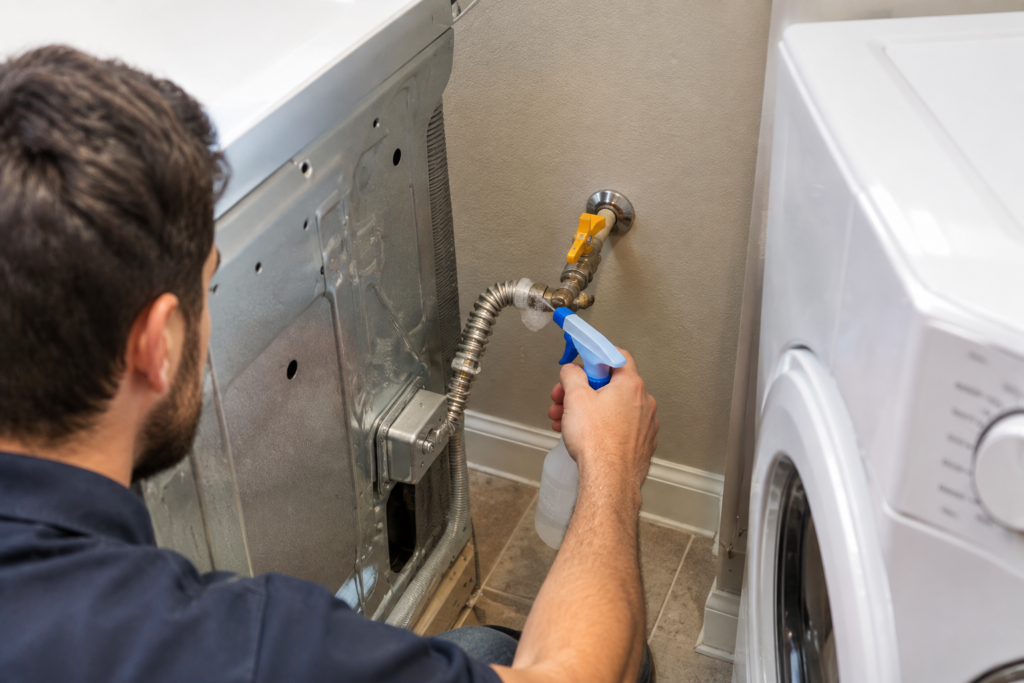
This is the safest and most reliable at-home method for spotting a leak. Mix a few drops of dish soap with water in a spray bottle or small cup, then apply it generously to every connection point: where the line meets the wall shutoff valve, and where it meets the back of the dryer. If gas is escaping, you’ll see small bubbles forming and growing at the leak point within a minute or two. No bubbles after a couple of minutes at every joint is a good sign, though it doesn’t rule out a leak further down the line.
Step 5: Listen and Feel
With the soap test done, take a moment to listen closely near the connection for any faint hissing sound – this is often easier to hear once the dryer itself is silent and the room is quiet. You can also run a hand slowly near (not directly on) the fittings; a leak sometimes produces a very slight, cool airflow sensation right at the source. This step works best as a secondary check alongside the soap test, not as a replacement for it.
Step 6: Check the Shutoff Valve
The shutoff valve where the gas line enters from the wall should turn firmly and sit fully open or fully closed – never partway. A valve that feels loose, doesn’t turn smoothly, or won’t seat properly is a separate issue from a leak at the fitting, but it’s just as important to have addressed, since a faulty valve can be a leak point of its own.
Step 7: Note the Ventilation Area
While you’re back there, take a look at the dryer vent and surrounding area. Gas dryers should always vent properly to the outside, and a cluttered, blocked, or damaged vent duct can sometimes mask early warning signs of other appliance issues by trapping odors close to the machine rather than letting them dissipate. This isn’t a leak indicator on its own, but it’s worth a quick visual check while you’re already back there.
What to Do If You Find a Leak
If the soap test shows bubbles, you hear hissing, or you’re simply not confident in what you found, don’t attempt to tighten fittings yourself. Overtightening a gas connection can crack a fitting or damage the threading, turning a minor leak into a bigger one. It’s a common instinct to want to fix a small leak with a wrench and call it done, but gas fittings are designed to be sealed with specific tools and techniques – a well-intentioned DIY fix is one of the more frequent causes of leaks getting worse rather than better. Instead:
- Turn off the shutoff valve at the wall if it’s safe and accessible to do so.
- Leave the dryer unplugged and don’t run it again until it’s been inspected.
- Ventilate the area by opening nearby windows if you can do so without lingering in a room with a strong odor.
- Call a licensed technician for proper diagnosis and repair.
Our team offers dedicated dryer gas line service for exactly this kind of repair, along with professional-grade tools like ultrasonic leak detection and non-invasive detection methods that can pinpoint leaks a soap test alone might miss – particularly if the leak is inside the wall or further along the line than the visible connection.
When the Soap Test Isn’t Enough
The soap test is reliable for catching leaks at accessible fittings, but it has limits. It won’t catch a leak inside a wall, inside the dryer’s internal gas valve, or anywhere along a line that isn’t exposed. If you’ve done the steps above, found nothing, but still notice a lingering odor, higher gas bills, or a hissing sound you can’t pinpoint, that’s a sign the issue is beyond what a homeowner can safely diagnose. At that point, our leak detection service uses equipment sensitive enough to trace leaks that aren’t visible or audible during a manual check.
Quick FAQ
How often should I check my dryer’s gas connection? A quick visual and soap-test check once or twice a year is a reasonable habit, especially if your dryer gets frequent use or hasn’t been serviced recently.
Is it safe to move my dryer to check the connection myself? Generally yes, as long as you turn the unit off first and move it gently. If your installation looks unusually tight to the wall or the flexible line looks stretched, it may be worth having a technician handle the inspection instead.
My gas bill went up but I don’t smell anything – could it still be a leak? Yes. Small leaks don’t always produce a noticeable smell, especially in a well-ventilated area. A rising bill with no other explanation is worth investigating with a soap test or a professional check.
Not Sure? Don’t Guess
A dryer gas leak is one of those problems where a little uncertainty is worth resolving quickly rather than living with. If you’ve gone through these steps and still aren’t sure what you’re dealing with, our team is on call for exactly this kind of situation, including 24-hour emergency response if you’d rather not wait. Not sure who handles this kind of repair? Our guide on who to call for a gas leak breaks down exactly that. Or contact us directly and we’ll help you figure out the safest next step.
Leave a Reply